I received a complimentary copy of this book through Netgalley for review purposes. I was not compensated for this review, and all opinions expressed are my own.
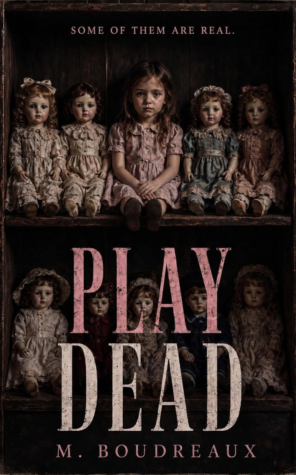 Play Dead by M. Boudreaux
 Published by M. Boudreaux on September 22, 2026
Genres: Psychological Horror, Thriller
Pages: 540
Format: eBook
Source: Netgalley
Buy on Amazon

The doll existed before the kidnapping.
Eighteen months after five-year-old Mia Dawson disappeared, her mother sees her again on a stranger’s livestream. She is sitting at the end of a child-sized table in a yellow chair, surrounded by hyperrealistic dolls, while thousands of viewers watch. The woman behind the camera calls her Annie. Kate knows better. She recognizes the split in Mia’s thumbnail, the notch in her ear, and the tiny details no artist should have been able to recreate by accident.
Nicole Perry has built an enormous online following around her seventeen “children,” complete with birthdays, favorite foods, bedtime routines, family photographs, and personalities her followers know by heart. Annie has been part of that family since before Mia vanished, which should make Kate’s theory impossible. Then the girl moves again. Police search Nicole’s home and find exactly what Nicole says they will find: dolls. Kate is left with one choice. If she wants to know what is really happening inside that house, she has to get close enough to see it for herself.
Using a false name, Kate takes a temporary job inside Nicole’s carefully staged world. Behind the cameras, locked rooms, household rules, and perfectly arranged family moments, she discovers something far worse than a woman obsessed with lifelike dolls. Children are being taught new names, new memories, and new versions of themselves. They learn when they are allowed to move, when they are allowed to speak, and how to become perfectly still when the red light comes on. Beside each living child is a copy convincing enough to take their place.
Mia is alive, but she is no longer the five-year-old Kate has spent eighteen months trying to bring home. The deeper Kate gets into Nicole’s system, the more she realizes that finding her daughter was only the beginning. To get Mia out, Kate will have to survive a house built to make truth look like obsession, convince people who have already been taught what to believe, and face the possibility that loving the child who came home means letting go of the child she lost.
PLAY DEAD is an uncanny psychological horror novel about missing children, manufactured memories, online spectators, and the terrifying power of a story repeated until everyone accepts it as truth. Sometimes the easiest way to hide a child is to put her where everyone can see her.
Play Dead by M. Boudreaux is a quick, compelling read with a strong premise and plenty of suspense. I was immediately drawn back into the Southern embrace of North Carolina (my home state), where the story unfolds. As a fan of psychological thrillers, I appreciated the tense atmosphere. Some may argue this book leans into horror, but I consider it a thriller—though that’s a debate for another time. There are no supernatural elements here, just “real” people committing horrific acts—which, in some ways, can be even more disturbing.
The book explores the world of child trafficking, as well as the way social media can groom viewers into participating in a perfectly curated life. Some elements could be compared to mommy vlogging, but it also plays on the creep factor many people feel when watching some reborn community members share their routines. Now, don’t mistake that for me saying this book attacks people who collect or create reborn dolls, because that would miss the bigger picture. The point is how much information we willingly put out there for anyone to see.
Ultimately, this book urges readers to reconsider sharing every detail of their child’s life online—or at least, it should. There are real predators in the world searching for personal details to exploit, unraveling the story of your life and, in the worst cases, using that information to take something far more precious: your child.
The author excels at setting up the story, providing just enough detail, and creating complex characters. However, I found the dialogue between characters less effective at times.
For example:
“What does A mean?” she asked.
“Available.”
“What does B mean?”
Nicole drew a line through the question on the form. “Backup.”
There are quite a few moments like this where the dialogue shifts between characters with very little indication of who is speaking or what is happening between the lines. This style—often called ‘floating dialogue’ in publishing—relies on bare lines of conversation without dialogue tags or action beats to anchor the reader. While it can create a fast pace, I occasionally had to pause and figure out who was talking. At times, it felt more like I was reading a script than a novel, and that style didn’t resonate with me the way the rest of the book did.
There were also a few minor errors—such as sentences or character names that didn’t quite make sense. For instance, toward the end, Mia’s mother is told she can’t contact the witnesses. Later, she describes one witness as a “woman,” then refers to the same person as a little girl. These small inconsistencies pulled me out of the story.
Overall, I thoroughly enjoyed the premise and suspense of Play Dead. The story transforms something as ordinary as sharing your life online into something deeply unsettling. Perhaps that’s what lingers with me most: the scariest elements aren’t supernatural—they’re things that could actually happen.
I’d really like to read this author again, and I want to note that 4 stars is a solid read for me—especially when I can so easily be distracted by details like the ones I mentioned above.
I would definitely recommend this book to others who enjoy psychological thrillers. Another thing to note: there is very little cursing (just once, and not even the worst of words) and no sexual content, making it a clean read for those who value that as well.

CW / TW:
This piece contains references to:
Child Abuse, Child Trafficking, Emotional Abuse
Recommended Age: 16+
About M. Boudreaux

M. Boudreaux is a Louisiana horror author, a mom, and somebody who has discovered that apparently the healthiest place to put certain thoughts is inside fictional people and then make their lives considerably worse. A lot of her stories grow out of trauma, grief, real life, and the things that stick around long after they should have left. Writing is a strange kind of therapy for her: take the thing, twist it into a story, put it on the page, and let somebody else lose sleep over it for a while.





Leave a Reply