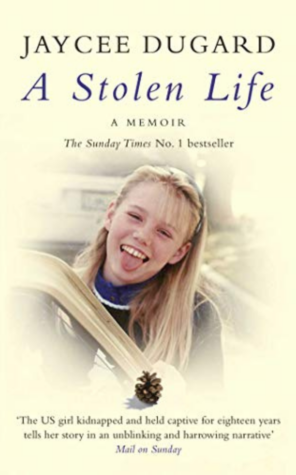
 A Stolen Life by Jaycee Dugard
 Published by Simon and Schuster on July 3, 2012
Genres: Biography & Autobiography, True Crime
Pages: 279
Format: Audiobook
Where to buy: Affiliate Link


An instant #1 New York Times bestseller—Jaycee Dugard’s raw and powerful memoir, her own story of being kidnapped in 1991 and held captive for more than eighteen years.
In the summer of June of 1991, I was a normal kid. I did normal things. I had friends and a mother that loved me. I was just like you. Until the day my life was stolen.
For eighteen years I was a prisoner. I was an object for someone to use and abuse. For eighteen years I was not allowed to speak my own name. I became a mother and was forced to be a sister. For eighteen years I survived an impossible situation.
On August 26, 2009, I took my name back. My name is Jaycee Lee Dugard. I don’t think of myself as a victim, I simply survived an intolerable situation. A Stolen Life is my story—in my own words, in my own way, exactly as I remember it.
A Stolen Life by Jaycee Dugard is the emotional, heartbreaking story of a young girl whose innocence was stolen from her—the life she might have lived, and a horror most people can’t begin to fathom.
In 1991, at just eleven years old, Jaycee Dugard was abducted while walking to her school bus stop. She spent eighteen years in captivity, hidden away from the world, before finally being rescued in 2009. Her story is both unimaginable and deeply moving, offering a rare, unfiltered perspective on survival. I chose to listen to this on audiobook after seeing so many reviews calling it “poorly written,” because I wanted a better sense of her voice and emotional state. And here’s the thing—Jaycee sounds like a child at times. She writes like one, too. And honestly? That tracks. I’m not a psychiatrist, but it feels like parts of her are still that 11-year-old girl who was taken and held captive by two monsters who abused her mentally and sexually. There’s a disconnect there, and you can hear it.
People should also remember, when reading this book, that Jaycee didn’t get to finish her education, which inevitably shapes how this story is told. While I did knock a half star off, that critique falls under editing, not Jaycee. The responsibility for smoothing out repetition or awkward phrasing belongs there, not with the person who lived through the trauma.
Jaycee Dugard is an exceptional woman who defied all odds and survived. Her captors, Phillip and Nancy Garrido, were ultimately brought to justice and are now serving life sentences in prison for their crimes. For those interested, more information about their sentencing is available from reputable news outlets. If you or someone you know has experienced trauma, organizations like RAINN (Rape, Abuse & Incest National Network) and the National Center for Victims of Crime provide support and resources.
Reading Jaycee’s words, it’s clear that recovery from trauma is not linear. Her journey is a powerful reminder that healing takes time and that survivors deserve patience, understanding, and support as they rebuild their lives.
Memoirs like Jaycee’s shine a light on the realities of trauma and resilience, giving voice to survivors who are too often silenced. Her openness helps others feel less alone and encourages important conversations about abuse, recovery, and justice.
This book left a lasting impression on me—not just for the horrors endured, but for the hope and strength that radiate from Jaycee’s story. I recommend it to anyone interested in true stories of survival and the unbreakable human spirit. She writes with hope, courage, and honesty about the fact that she was still healing at the time—and she never pretends otherwise.
This is a heavy book because it’s her reality. Reviews that criticize her for going into detail about her experiences feel misplaced.
What makes A Stolen Life by Jaycee Dugard stand out as a memoir is its rawness. This isn’t a neatly packaged true-crime story or a dramatized retelling—it’s fragmented, at times repetitive, and deeply human. That honesty may not align with what some readers expect from a polished memoir, but it reflects the reality of trauma and memory. Survivors don’t tell their stories in perfect structure; they tell them in pieces, in loops, in moments that still feel present. In that way, this book succeeds not as a traditionally “well-written” narrative but as an authentic account of survival, captivity, and resilience.
With this book, Jaycee Dugard proves one thing: monsters exist—but so does hope.

CW / TW:
This piece contains references to:
Kidnapping, Rape, Sexual Assault, Pedophilia, Emotional Abuse, Physical Abuse, Animal Abuse
Recommended Age: 18+
About Jaycee Dugard